
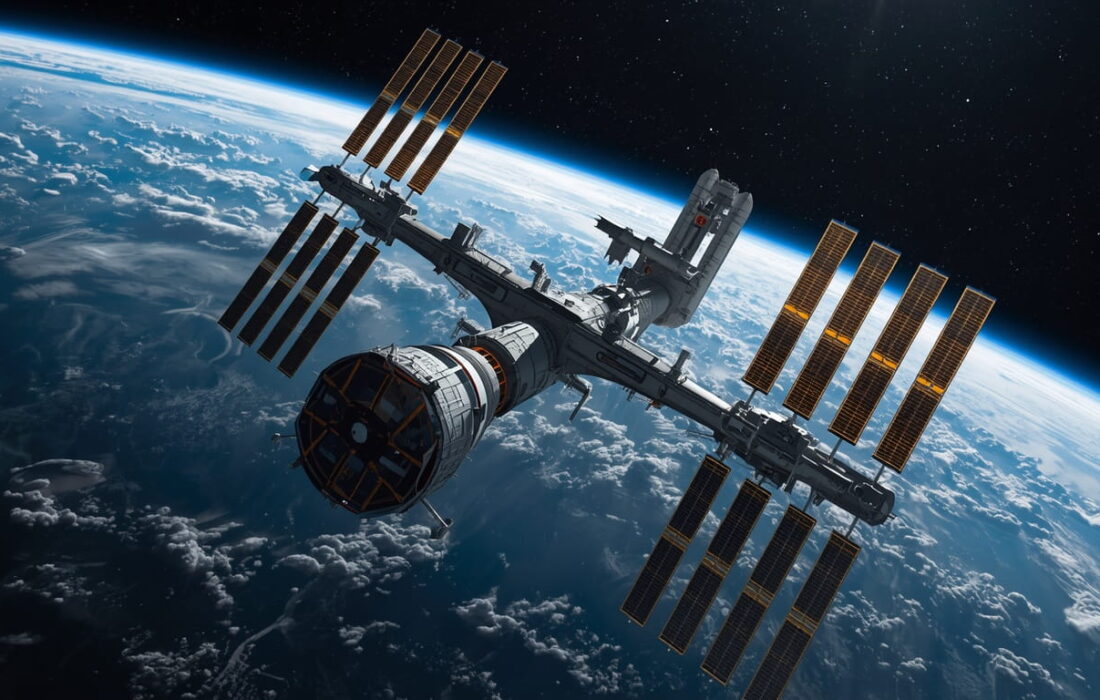
The International Space Station was the last vestige of human life in the quiet stretches of space above Earth; a grand transformation is afoot. Faced with their competitors in the space of these days, private firms are no longer willing to ride on government rockets or to rent a small module on an old orbital station.
Rather, they are constructing, launching and maintaining their own free-flying habitats, creating a very crowded marketplace in the vacuum of space. This shift from taxpayer-funded outposts to orbital businesses that turn a profit will be one of the biggest technological and economic achievements of the decade, with potential applications ranging from pharmaceutical advances developed in microgravity to the next level of luxury experiences for the super-rich.
It took time for the commercialisation process to take over. Over the years, it was built on the vision and foresight of progressive entrepreneurs and the support of progressive policies. The initial private efforts, including cargo delivery to the International Space Station, demonstrated that it was feasible to access space at a reasonable cost.
The technology of reusable rockets reduced the cost of launching rockets from tens of millions to just a few hundred thousand dollars per kilogram, allowing smaller firms to compete. By the middle of the 2020s, a number of companies had begun making bold statements about their plans for commercial stations of their own, built with no consideration for the red tape the international community would face.
The exploration of space beyond low Earth orbit was, for almost six decades, limited to the national space agencies. The International Space Station itself was a feat of engineering involving several countries, and the collaboration entailed challenging political arrangements that sometimes impeded innovation. The retirement period was in the late 2020s, and it was a challenge and an opportunity. Instead of an empty space in space, the industry developed designs based on commercial return on investment, rapid expansion, and modularity.
A consortium of aerospace giants and start-ups has created one of the pioneering stations, an inflatable habitat designed to expand in orbit to several times its launch size. These kinds of structures utilise highly abrasive, radiation-resistant, and micrometeorite-resistant advanced composite materials, and a section for artificial gravity with rotating modules.
Another contender is a sleek, metallic design optimised for zero-gravity production, with multiple docking ports for cargo and crew vehicles. But all these projects share one thing: they are autonomous, with no government control or international command centre. Rather, the decisions are made based on market demand, investor returns and customer contracts.
Key Innovations Enabling Commercial Viability
The technical problems of maintaining a profitable station were huge, but recent developments have overcome these obstacles. The efficiency of solar power arrays has surpassed what was once believed possible, and they now produce megawatts of clean energy using small, foldable panels that unfold in space, like a crumpled-up origami box.
The life support systems can recycle water and air nearly perfectly, and are based on lessons learned from closed-loop ecosystems tested on the ground. Propulsion technology has also made a huge leap, with the development of ion thrusters and plasma engines, which enable more subtle, sustained adjustments to a station’s orbit, thus reducing the need for frequent refuellings.
One of the most impactful changes is the introduction of AI in all facets of the business. Systems onboard automatically monitor structural integrity, predict structural health and optimise use of resources. When present, crew members interact with intuitive holographic interfaces, not clunky control panels. These innovations help lower the operating costs of the stations to less than a fraction of what government programs previously had to pay for and allow stations to offer services, including long-duration scientific research at a competitive price or refuelling satellites.
Applications Transforming Industries
Other uses for these orbital platforms could include research institutions and spaceports, though a zero-gravity hotel with a view of Earth is already set to begin accepting bookings years in advance. In microgravity, it is possible to synthesise materials that can’t be synthesised on Earth. Without sedimentation, crystallised proteins are purer and thus faster in the development of pharmaceuticals for diseases that for a long time have been difficult to cure.
In the absence of gravity’s effects, fibre-optic cables made in orbit are of higher quality and greater strength. The unique environment is also expected to enable the production of lighter, stronger components for consumer electronics, electric vehicles, and other everyday products, such as alloys and semiconductors.
Commercial stations are becoming scientific hot-spots as well as an industry. Universities and research institutes are now leasing lab space instead of waiting years for a precious opportunity to become available in government facilities. The weather in the atmosphere and the borders between countries don’t matter to climate scientists.
Sensors are used by astronomers to detect signals emitted by objects in space, allowing them to be seen more clearly. Astronomers use sensitive telescopes which are protected from interference from Earth. The stations also act as test beds for the technologies of Mars and Moon exploration, life support and habitats, and propulsion.
With the excitement comes some setbacks, though, for commercial space stations. With an increased number of objects in low Earth orbit, Orbital congestion is on the rise. The risks of collision require advanced traffic management systems that go beyond the control of individual companies. Space debris remains a problem: new international guidelines have been established for end-of-life disposal, but enforcement is not consistent across countries.
Rules and regulations are still lagging behind innovation. Issues concerning liability for accidents, space IP and environmental effects of regular launches are still up for discussion in international fora. Some are concerned that profit motives might affect safety or that companies would be more interested in short-term profits than long-term sustainability. Supporters argue that competition will lead to increased safety, for example, through innovation, because of the success of private launch companies.
A New Chapter in Human Spaceflight
The wider impact of the first commercial stations is already changing the way humans relate to space, with their first crews soon to be on duty. Astronauts and engineers are no longer the only ones who can enjoy space; now scientists, entrepreneurs, and ultimately regular people can, too. In the next decade, one might expect to see hundreds of billions in revenue generated by the orbital economy, with all kinds of jobs, from space welders to orbital tour guides.
This new chapter does not just involve technology and business; it is the growth and extension of human civilisation. People will live and work in space as consumers, not guests of governments, in a vibrant marketplace for the first time. Access to the view from orbit will be available to all and become part of everyday business. There are challenges to overcome, technical reliability and ethical issues, but the momentum is undeniable.
As these stations grow in number and are interconnected in the coming years, they could create a space infrastructure network. Satellites will not be replaced, research will be sped up, and new industries will grow which we can hardly imagine today. Commercial space stations, more than a feat of engineering, are the first steps of mankind’s permanent presence outside of our home planet, inscribed not with treaties, but in the accounts of innovation and enterprise. Previously, the stars were too far away and impenetrable, but now those who are fearless enough can reach out and grasp them.