
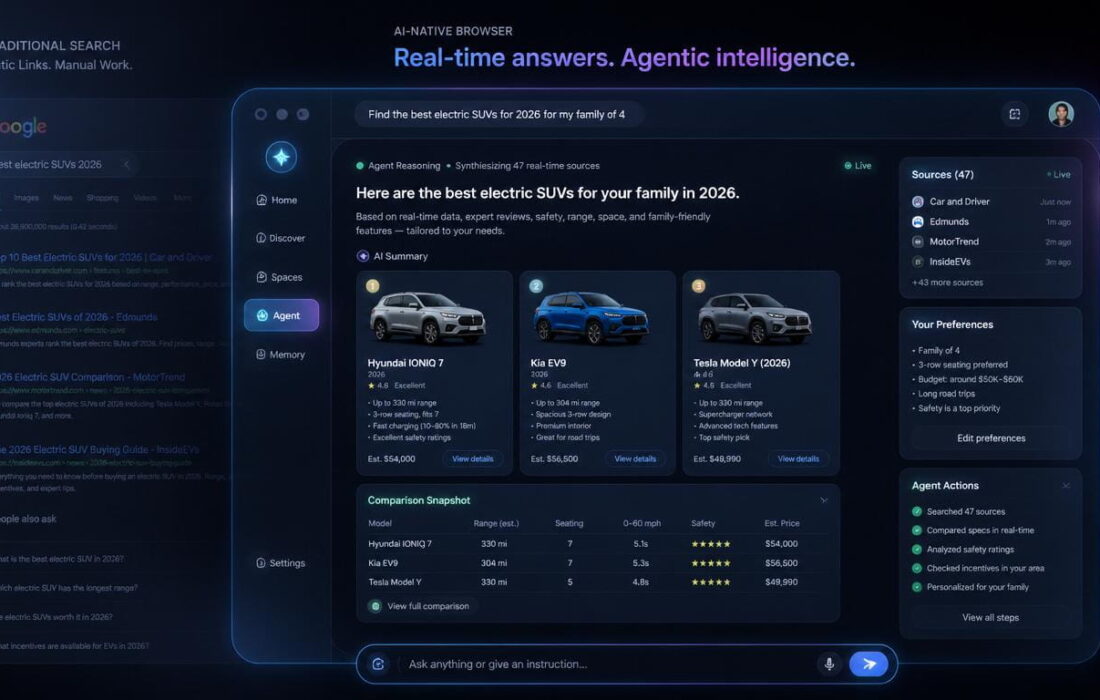
Opening a browser, typing a search query into a search bar and flipping through pages of blue links is a habit that seems to be a thing of the past in the spring of 2026. A new generation of web browsers has quietly entered the market, changing the way millions browse the Web. These tools are more than just the tab manager or ad blocker.
They comprehend natural language, can combine information from dozens of pages in real time, and can even perform complex operations on a user’s behalf. The traditional search engine is experiencing the biggest shake-up in its history since the proliferation of mobile Internet browsing, and the entire Web is becoming more conversational, personalised, and independent.
There is one major distinction between the two browsers: how they deal with information. The traditional search approach does not depend on the user to find the right answer, but requires the user to sift through the results, cross multiple sites and, ultimately, construct the answers. On the contrary, AI browsers turn this model on its head. They have no list of links to deliver; they can respond directly and contextually in real time using live data on the Web.
You ask for the best hiking trails in Hyderabad for the monsoon season, and the browser may retrieve current weather reports, local forums’ reviews of trails, and user reviews based on the trails they’ve visited in the past, and even recommend equipment based on their browsing history all in a nicely formatted, easy-to-read weather summary with follow-up links for each. This “zero-click” experience allows for much less friction and results in longer time spent on the site, within the browser.
The one thing that makes these AI Web Browsers stand out is the change in terms to ‘agentic’. Earlier, the AI was limited to being embedded in the browser’s search bar, providing snippets or chatbot answers. The best models today can plan and execute multiple steps on the web. Looking to go on a weekend holiday?
While you’re watching or editing prompts, the browser can do the research, compare hotel rates, check availability on booking sites, create an itinerary, and even add a calendar event. This puts the browser in an active role rather than simply handing over the keys, and ensures that browsing sessions are effective and efficient, not random research rides.
This breakthrough hinges on technology that integrates big language models, web connectivity, user context memory between sessions, and streamlined automation agents. There are privacy-preserving choices that will run certain processes locally on the device to restrict information sharing, and others that will utilise cloud models for more advanced reasoning. In any case, the outcome is a browser that seems to be anticipatory. It will recall your preferences, perform repetitive tasks, anticipate what you want to see next on a webpage, or highlight outdated information if you return to a page you’ve visited before.
The business models of traditional search engines were centred around ranking pages in a complicated manner and indexing the web. That’s a great one that worked like a charm for years as there was no better option for the users. But, with the advent of AI browsers, this ground is being undermined as they better meet user intent. Initial results from 2025 revealed that overall traffic from traditional search engines was declining, while traffic from conversational interfaces was rising.
Initial information from 2025 indicated a measurable drop in traffic from traditional search engines and an increase in traffic from conversational interfaces. A major portion of the everyday queries (particularly research-heavy or decision-making) now go straight to the search engine without going through it, according to the analysts at the end of 2026.
The change has important implications for the web’s economic ecosystem. It’s time for content creators and publishers to rethink their strategies because they were optimising for search visibility by keywords and backlinks. While not always the case, AI browsers tend to rephrase and/or summarise your content and not create direct traffic.
This means that although the information is returned in the response, sites may not get as many visitors as they would otherwise. Some publishers are trying out machine-readable data formats, which they hope will be preferred sources for AI synthesis. Still others have concerns about losing ad revenue and about the possibility that the value of original reporting may become less important as people increasingly use news and analysis exclusively through summaries.
But businesses are adapting as well. AI agents can seamlessly complete purchases thanks to deeper API integrations on e-commerce platforms. E-commerce platforms are deepening their API integration so that AI agents can seamlessly complete e-commerce purchases. Marketers are looking to make their product pages more “understandable” to AI that can compare competitors’ product options in mere seconds. The whole attention economy is shifting from CTR to conversational relevance and task completion rates.
However, there are challenges for AI browsers to address. One of the key issues is accuracy—even sophisticated models sometimes get certain details or nuances of the context wrong, and provide incorrect recommendations.
But privacy advocates are concerned about the vast amounts of behavioural information these tools collect to provide a personalised experience. Browser vendors respond with clear opt-in mechanisms and processing within the browser, and privacy and convenience will become the general theme of regulatory debates in the near future.
Accessibility is also a factor, as is digital literacy. Agentic workflows are embraced by power users, but for many internet users every day, it may seem like too much to deal with interfaces that make it difficult to distinguish between human choice and a machine’s action. It’s important that these tools are easy to use and not mandatory, and therefore not intrusive.
The future of AI browser technology is promising, as it transforms the web into a more interactive and intelligent environment. Now, navigation isn’t so much about finding out as about getting things done. Discovery goes from random clicking to exploration and discovery that fits an individual’s objectives. There is not much difference between search, browse and productivity software anymore.
Browsers give users a welcome respite in fast-paced scenarios, such as the tech boomtowns of India, where the time it takes to switch between tabs and apps can rob them of productivity. They say they will shrink the Internet, smarten it up and make it more responsive to human needs. Traditional search isn’t going anywhere; it’s still the best solution for finding quite a bit of stuff and for some more exact searches, but it’s being shifted from a default gateway to a special tool.
The full consequences of this switch are yet to be realised. One thing is for certain, though, the “little window” that is the web browser is not only a gateway to the web. It is becoming a wise ally for our online experience, decision-making, and design. While AI browsers are certainly threatening traditional search, they are evolving and not just competing with it. They’re tampering with the rules of digital life, with the permission of nobody and the knowledge of no one.