
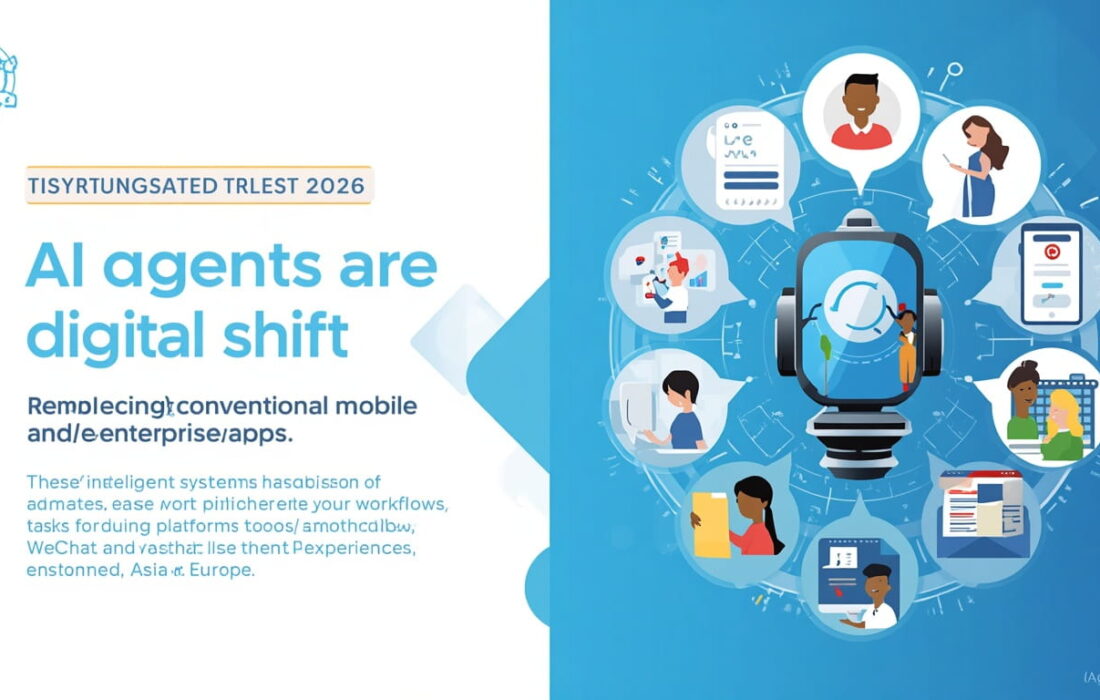
As AI agents are quickly becoming viable alternatives to traditional mobile and enterprise apps, they are transforming the digital world in 2026. As technology advances, Asian and European market leaders are seeing a transformation in how applications work, changing from static to goal-driven AI systems that can tackle complex tasks with little human involvement.
This shift has paved the way for agentic AI, where intelligent agents can initiate workflows, make decisions, and take actions on multiple steps. AI agents operate without the need for user navigation will be more efficient and personalized than traditional applications.
This revolution is at the forefront of China. Super apps and major platforms such as WeChat are getting increasingly sophisticated AI agents to manage ecommerce to everyday planning. A user can just say what they are looking for (for instance, to book a trip or to work with their shopping list), and the agent takes care of the rest, working through the various integrated services.
Honor’s recent on-device UI Agent is an example of these systems conducting actions directly on the phone interface without the need of external APIs. The strategy helps to protect privacy while providing the seamless experience that’s expected by the high number of people using mobile devices for AI computing, which will grow rapidly in the Asia-Pacific region.
The super-app structure is a key advantage of Chinese ecosystems, which enables AI agents to function within the extensive, complex environments of these ecosystems, according to industry analysts. More than 600 million people in the region are already interacting with agentic features and are well on their way to a future where AI makes purchasing decisions and coordinates services.
Enterprise Transformation & Projections
The effects are far reaching in the business. By the end of 2026, Gartner predictively expects to see less than 5% of enterprise applications without AI agents for tasks, up from only 1% in 2025. They are great at automating a lot of repetitive tasks, whether in customer service or in supply chain management, and free professionals up to focus on more high-value tasks.
In the EU, projects on digital sovereignty are facilitating such integrations. Companies are integrating agentic capacities to help them meet the requirements of the local data rules and improve operations. This brings up a hybrid approach where AI agents complement and amplify existing software, leading to smarter and more responsive digital tools.
This change is beneficial for regular users as there will be less applications on their device. A single AI agent can orchestrate requests across services, rather than having to change between them. Developers are developing Autonomous and Natural Language-Governed Architectures that give greater importance to natural language interfaces and autonomous execution over conventional GUI interfaces.
Despite these advances, there are still a number of challenges to overcome, such as reliability, decision making with hallucinations and ethics of autonomy. But these problems are being overcome by continuous progress in on-device processing and multi-agent collaboration.
The digital experience is becoming more intuitive and proactive as AI agents continue to grow. This next generation of innovation isn’t just about making apps better and more useful, it’s about a new way of thinking about how people and businesses relate to technology, and how that relationship will be more efficient and intelligent in the future.