
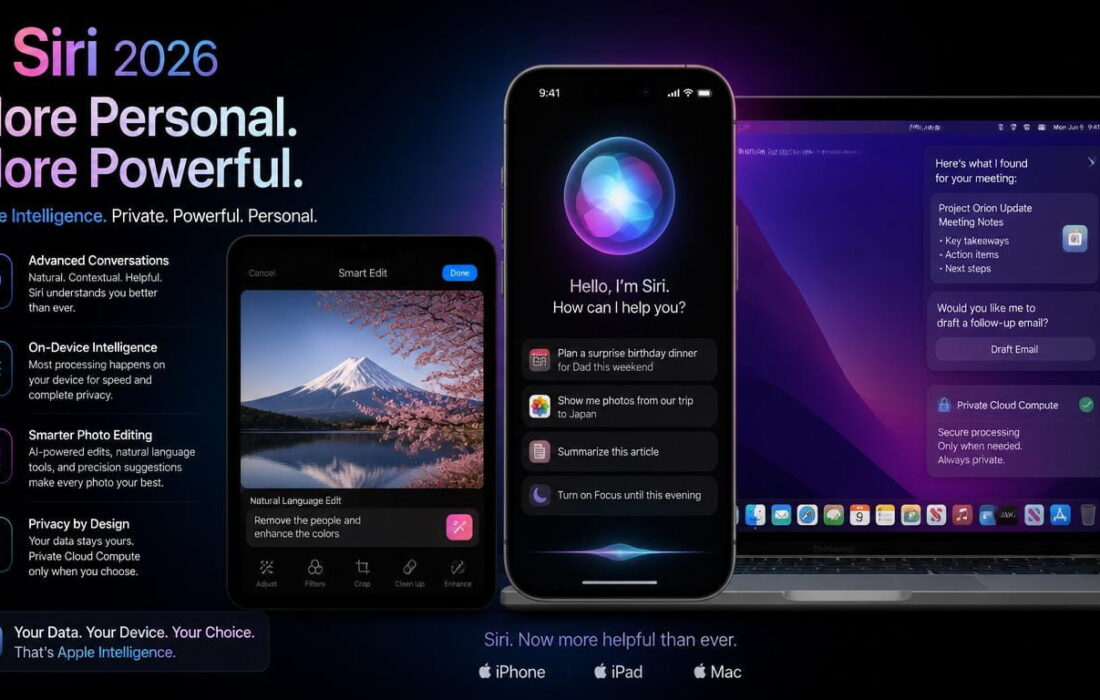
Apple has introduced the second iteration of its AI-powered Apple Intelligence platform, with a hugely improved Siri AI at its core that will change the way users interact with their devices. The changes were announced earlier this summer at the Worldwide Developers Conference, and now they’re making a splash as beta testing rolls out and the launch is nearing later this year. The move positions Apple to be more competitive in the fast-changing world of AI, where privacy and seamless integration are two decisive features.
The new Siri AI is a radical transformation of Apple’s longstanding virtual aide. Beyond basic instructions, it can now engage in natural conversations and exchanges, leveraging the latest Apple Foundation Models developed in partnership with other companies, such as Google.
Users can pose a complex question that includes personal, web, and app information. For example, Siri AI can analyse emails, messages, and photos to present customised suggestions or perform multiple tasks with voice commands, such as arranging travel plans or editing photos. A new Siri application also enhances the system’s accessibility and enables deeper integration across iOS, iPadOS, macOS, and other operating systems.
Apple’s approach is always to prioritise privacy. Much of the system’s intelligence is implemented on the device rather than in the cloud, reducing the amount of data transmitted and enabling strong protection measures. New parental controls allow parents to enforce safer digital limits and include intuitive tools for monitoring and controlling app usage. These enhancements come alongside other software enhancements in iOS 27 and other operating systems, which enhance performance, responsiveness, and delight across iPhones, Macs, and wearables.
This timing is seen as a response to the growing need for practical, user-friendly AI that doesn’t overpower people. For instance, the Image Playground tool now lets you create photorealistic images directly from Photos, and Safari’s AI playground updates its browsing tools to be smarter. The features could encourage the hundreds of millions of Apple device users worldwide to adopt the technology and spur innovation among competitors.
As excitement grows, engineers are already using these tools to create new applications that will be made public in the near future. There are still some challenges to overcome, such as ensuring reliability across a wide range of scenarios and addressing concerns about AI hallucinations or biases. However, early demos show that Siri now has better context recognition and can actually take some initiative, making it more of a companion than an assistant.
This is a step forward toward Apple’s innovative approach to hardware-software integration. The company’s reliance on external servers is reduced thanks to the on-device processing capabilities of recent iPhones and Macs, which use powerful chips to enable artificial intelligence. With the technology’s maturity, the possibilities seem endless, from home automation to health monitoring and beyond.
Both tech enthusiasts and investors are closely watching these elements, hoping to see how they spur device upgrades and ecosystem loyalty. Though the effects will be felt over the years, Apple’s current actions demonstrate a bold move towards an AI-powered future that unites cutting-edge features with the reliability consumers have come to expect. As technology stands poised to become more personal, more helpful, and more secure for millions of users worldwide, the coming months will tell us whether this new Siri AI will deliver on those promises.