
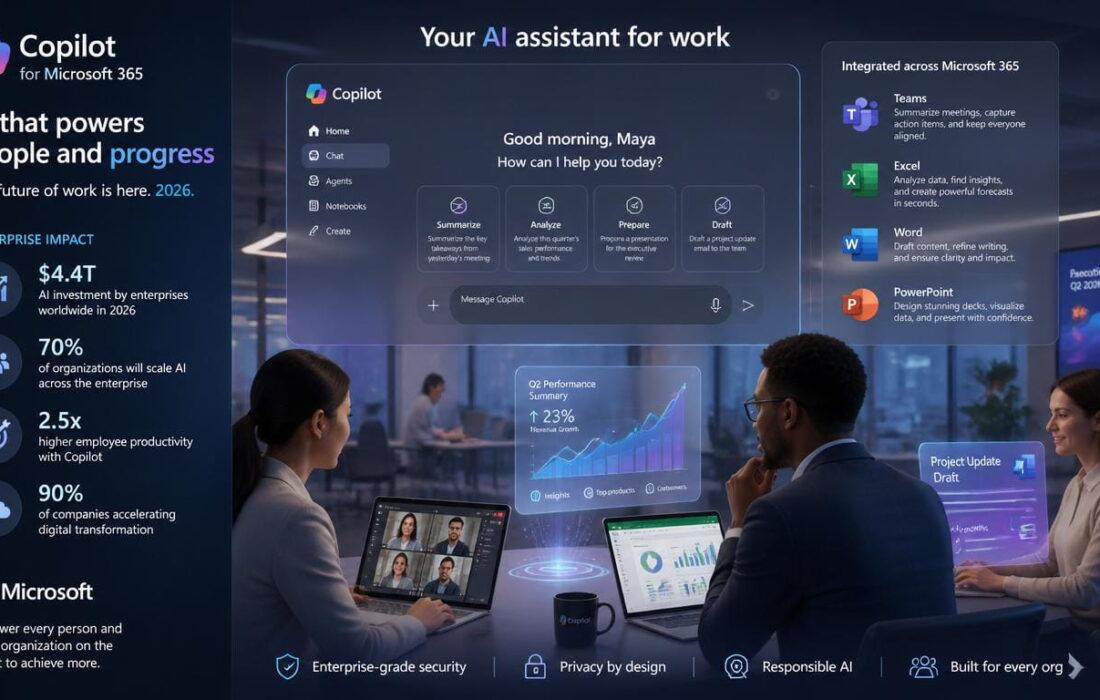
As the enterprise technology landscape continues to evolve rapidly, Microsoft Copilot has become an integral part of the AI-driven transformation. In 2026, as organisations invest more in their AI initiatives, Copilot is more than just a productivity tool; it’s a strategic powerhouse shaping the future of team collaboration, innovation, and execution.
The uptake of AI tools such as Copilot is accelerating, with investment in such tools expected to exceed previous estimates by a significant margin across Fortune 500 and mid-market companies. The trend is driven by a general shift towards the real implementation of AI in business, away from the pilot phase and towards tangible results of the growing business investment in AI.
It is this understanding that AI is no longer a luxury but a necessity for enterprises aiming to stay competitive that is driving the surge in enterprise spending on AI. More than three-quarters of large companies have expanded their share of AI funding this year, and Microsoft’s ecosystem is getting a big piece of the pie, according to global surveys.
Copilot’s capabilities are seamlessly integrated into familiar Microsoft 365 applications, such as Teams, Word, Excel, and PowerPoint, reducing the learning curve and enabling employees across departments to access these advanced features without difficulty. From a simple smart assistant, it has since become a comprehensive system that can coordinate complex processes, analyse large amounts of data to draw conclusions, and even predict user needs before they arise.
As Copilot scales across enterprises’ digital infrastructure, they are seeing greater operational efficiency than ever before. The tool now automatically performs complex financial modelling, compliance reporting, and anomaly detection with a remarkable degree of accuracy across the finance and accounting divisions.
One of the world’s largest banking companies recently reported that it has saved almost 40% of its analysts’ reporting time in its quarterly report by using Copilot as part of its core systems, allowing it to spend its time analysing data and providing strategic advice instead of handling mundane data crunching.
Back-office functions are not the only tasks that can be adopted. Copilot is helping sales and marketing teams to build list-based marketing campaigns and segment their messaging to resonate with individual customers, leveraging past interactions and market signals to recommend the best message and timing. It’s a tool that helps human resources professionals streamline talent management, from developing job descriptions that fit a changing skill set to simulating interview scenarios to better predict cultural fit.
With its ability to learn from data within an organisation and its robust security protocols, the platform has proven to be a safe choice for regulated industries such as healthcare and government, tackling one of the major issues in data governance. One of the challenges in data governance has been addressed with its ability to learn from data within an organisation and robust security protocols, making it a trusted choice for regulated industries like healthcare and government.
Microsoft has taken the steps to meet this demand, continually improving its product for enterprise-scale environments. Updates in early 2026 will bring more customisation for businesses, enabling them to precisely control Copilot’s actions to better suit their unique workflows and terminologies. This enhancement has helped shorten ROI timelines, with many companies seeing returns in less than six months, compared to the years previously experienced with AI investments.
Synergies with Broader AI Ecosystem Amplify Impact
The power of Copilot’s momentum lies in its seamless integration into the broader AI landscape that enterprises are developing. Copilot serves as a glue layer that integrates and coordinates various tools and data sources, making AI more accessible across the company. As companies expand their AI portfolios, Copilot is designed to serve as a glue layer that integrates and coordinates tools and data sources, making AI more accessible across the company.
It works with systems such as sensors for the Internet of Things and predictive analytics in manufacturing to optimise production schedules in real time and reduce waste and downtime. Copilot is being woven into multimodal AI systems, enabling retail giants to design a seamless experience for their customers from browsing online to navigating their store.
This interoperability has spurred enterprises to try things more extensively. The budgets have spread among various vendors and now focus on Microsoft’s infrastructure, Azure, which links to a new intelligent interface, Copilot. According to chief information officers, this single strategy can cut down on integration expenses by as much as 25% and enhance the reliability of the system.
Additionally, Copilot’s agentic features, which enable tasks to be completed independently across different applications, align with the broader shift towards autonomous AI systems, making this an ideal starting point for businesses moving towards more sophisticated implementations.
Security and compliance remain paramount, and Microsoft has done more than work on enterprise-class security measures. The addition of advanced encryption, audit trails, and responsible AI guidelines woven into the core of Copilot has helped alleviate risk-averse boards’ doubts. With increasing regulatory pressure worldwide, these built-in protections have become an important consideration for procurement and are contributing to their growing uptake.
But despite promising progress, enterprises are taking a cautious step forward in expanding AI. These issues with data privacy, potential bias in analysis results, and the need for employment reskilling need to be addressed.
AI leaders are placing a strong emphasis on providing all-in-one training initiatives to empower staff to work alongside Copilot rather than in opposition. Even when used as an addition to human ingenuity, not a replacement, organisations that recognise the tool as an aid to innovation and engagement are enjoying the highest levels of both.
Future plans and outlook: Microsoft Copilot’s journey is likely to continue, with its impact potentially increasing further. Road plans for the future suggest improved multimodal processing and greater integration with new technologies like edge computing, which will expand its use in real-time operational environments. Copilot is poised to be a key enabler for businesses to find new revenue streams and business models in the second half of 2026 as they invest more in AI in their capital expenditure.
Microsoft Copilot’s journey towards 2026 is a tale of growth and growth. What started out as a visionary idea has become a proven formula for enterprise value, embraced by investors and backed by results.
As business leaders adapt to the ever-evolving world of technology, the message is clear: strategic investment in tools such as Copilot is not just a way to keep up; it’s shaping the future of work. Intelligent humans who do so judiciously now will be best suited to run the AI-powered organisations of the future.