
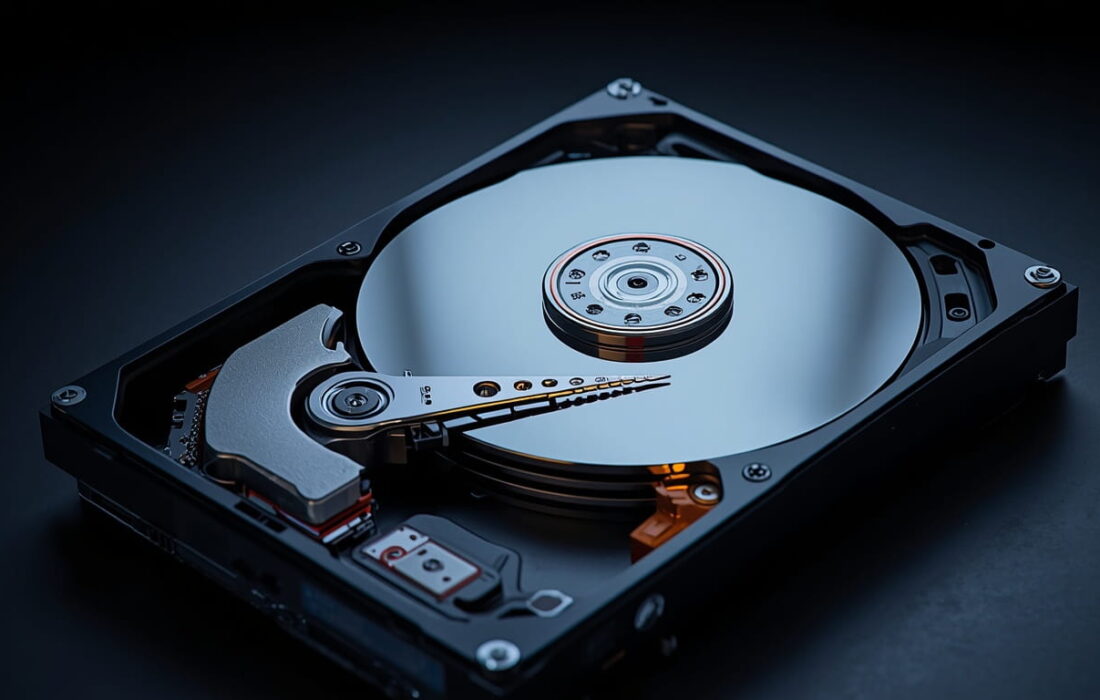
The storage industry is about to make a major advance. The engineering and research community worldwide has been making rapid progress towards developing consumer- and enterprise-driven devices capable of handling 100 terabytes of data by 2029.
The highly anticipated development, eagerly awaited by data centres, cloud service providers, and tech enthusiasts alike, will undoubtedly redefine the landscape of data storage, management, and access worldwide.
The capacity of hard drives has been increasing steadily over the years, but at an even faster rate in recent years. Ten years ago, having 1 TB of hard drive space was plenty for a personal computer. Available today are 20TB and 30TB drives, and manufacturers have been relentlessly working to increase magnetic storage capacity.
The transition to 100 TB is underway, but it isn’t due to the emergence of a single magic technology; it’s driven by multiple cutting-edge innovations. At the heart of this revolution is a new type of magnetic recording technology called Heat-Assisted Magnetic Recording (HAMR).
Unlike magnetic recording, HAMR relies on a micro-laser to heat a small area of the disk platter for brief periods, enabling data to be recorded on much smaller, more stable magnetic grains. The density of data that can be stored per square inch has increased dramatically.
One of the largest hard drive manufacturers, Seagate, has been one of the loudest proponents of HAMR. The company has publicly shared a roadmap that will make 100 TB drives available by the end of this decade, on top of its Mozaic platform, which already has commercial 100 TB+ drives.
Why is 100 TB Important in Data Centers?
The significance of 100 TB hard drives extends beyond personal computers. As datasets grow larger, people around the world are consuming vast amounts of storage space at an unprecedented rate, thanks to the rise of artificial intelligence training sets, video streaming, cloud computing, genomic research, and the proliferation of IoT devices.
Up to now, data centres have been taking up a lot of space and energy to accommodate the number of drives required for storage. Five to six 20 TB drives will be replaced by a single 100 TB drive, resulting in fewer drives per rack, lower power per TB, reduced cooling requirements and overall reduced physical footprint. This efficiency can yield significant cost savings and environmental benefits for hyperscale cloud providers managing hundreds of petabytes of data.
In addition to enabling smaller enterprises and managed service providers to scale storage infrastructure without scaling hardware costs and data centre space, the economics of higher-capacity drives also help them out.
Issues Remaining to be Addressed
However, even with all these advancements, there are still hurdles to mass-market 100 TB drives. One of the key challenges is ensuring data reliability at these extremely high storage densities. The smaller the magnetic grains become to fit more data, the more the data may deteriorate over time because the tiny grains may be unstable due to heat from the data. HAMR technology overcomes this problem by using materials with higher coercivity, but manufacturing such materials at scale with consistent quality is technically challenging.
The speed at which one can read and write is also a problem. Hard drives have traditionally been characterised by rotational speed; although the amount of information on each platter of hard drive memory is growing, there is no corresponding decrease in the time needed to access it. Manufacturers are working on optimising designs of read/write heads and data management algorithms to overcome the performance bottlenecks.
Cost is another factor, too. Initial versions of 100TB drives are likely to be pricey and will be found mostly in enterprise customers. As manufacturing volumes and processes mature, consumer pricing is expected to become more competitive.
The Competitive Landscape
This race is far from being a one-man show. Western Data has been developing its own next-generation recording technology, in parallel with higher-density approaches such as microwave-assisted magnetic recording (MAMR). Toshiba is also funding the development of new recording technology. The competition among these leading manufacturers to do the job more quickly and cheaply will surely accelerate the process and reduce costs for each company.
Meanwhile, SSDs are improving, too, and are still more expensive per TB than high-capacity hard drives. In the case of bulk storage, spinning hard drives are likely to have a cost advantage for a long time, into the 2030s.
Analysts expect a phased deployment of the service that won’t hit 100 TB at once. The drives with capacities of 40 TB to 60 TB are expected to be commercially available within 2 years, followed by 80 TB drives. Limited enterprise release will reach the 100 TB level by 2028-2029, and it will become more widely available as production scales.
The 100 TB drive is one of the biggest milestones ever for magnetic recording storage, and will continue to drive the world’s digital infrastructure for years to come.